 Kousatsu NoteReading the stories of games, films and anime through their own words
Kousatsu Note / Elden Ring / People
 GamesElden Ring People
Who Is Merchant Kalé in Elden Ring? The Wandering People "Spurned by the Grace of Gold", and the Code of a Clan Buried Alive
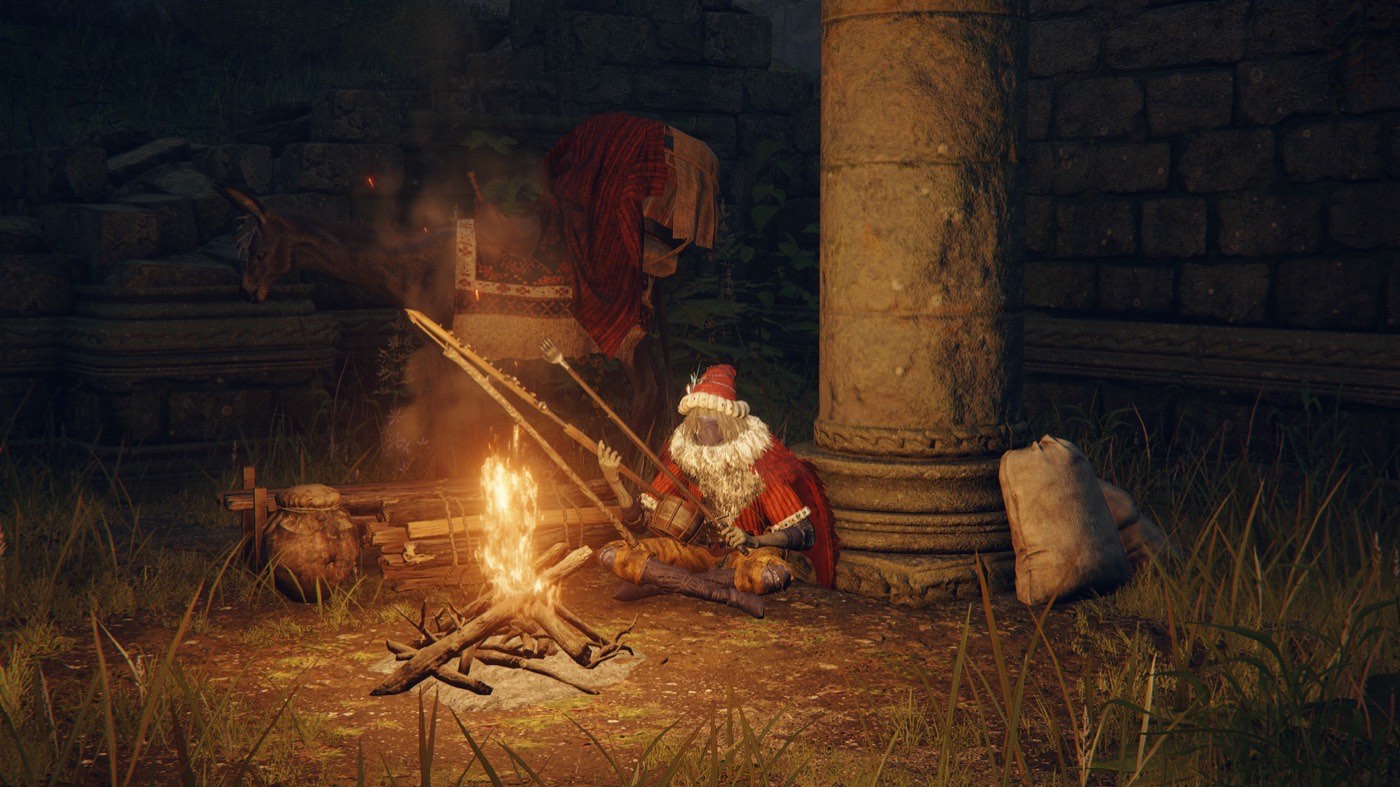
Kalé is a travelling merchant warming himself by a fire at the Church of Elleh in Limgrave. He comes from a nomadic people, who "have long been spurned by the grace of gold". Because of that, they could never settle, and were forced into a poor, unending journey. Kalé says this makes them "kindred spirits of sorts" with the Tarnished, who lost grace. His people have a code. "Lament not your solitude. Expect no sympathy. No regard. Nothing. But if anyone dares harm us, show them no mercy." And merchants of the same people were once accused of heresy, rounded up with their whole clan, buried alive far underground, and summoned the Frenzied Flame with a curse of despair. Kalé, we think, is something like the last of a clan left outside the Golden Order who could still stay sane.
Who is Kalé?
Soon after you step out into Limgrave, a man sits warming himself by a fire inside a ruined church. A bearded merchant in a red hat and red clothes:
You’re a Tarnished, I can see it. And I can also see… That you’re not after my throat. Then why not purchase a little something? I am Kalé. Purveyor of fine goods.
—— Merchant Kalé
I can also see that you’re not after my throat. From his first words, you can tell that Kalé lives on his guard. In the Lands Between after the Elden Ring shattered, almost everyone you meet is an enemy.
For many players, Kalé is the first merchant. And he does not just sell things; he worries about the player too:
You know, if you can spare the runes, you should buy yourself a crafting kit. A crafting kit allows you to make basic items on your own. Essential really, if you intend to survive out here for any duration. The kit costs a bundle, and I admit, I do take my cut. But the important thing is that you survive. Every customer counts, after all.
—— Merchant Kalé
Who are the “nomadic people”?
This is the heart of every Kalé theory.
Kalé tells you where he comes from:
I am of a nomadic people. Selling wares as I travel. The land has been tainted by madness since the shattering of the Elden Ring. It’s only Tarnished like yourself who keep things from drying up entirely.
—— Merchant Kalé
And he tells you a little more about his people:
There are others of my people who yet survive in these lands. If the mood takes you when you meet one, then offer them some trade, won’t you? My people, wanderers all, have long been spurned by the grace of gold. Which is why we cannot settle, but instead are forced into this pitiful, unceasing journey. But thanks to that, things are not so different for us now, though the Elden Ring is shattered. I think this makes us kindred spirits of sorts. Your people, the Tarnished, and mine.
—— Merchant Kalé
My people, wanderers all, have long been spurned by the grace of gold. Which is why we cannot settle.
In the world of the Golden Order, only those who received the grace of gold were proper residents. The nomads, without that grace, were allowed to live nowhere, and had no choice but to keep travelling.
Thanks to that, things are not so different for us now, though the Elden Ring is shattered.
It is an ironic line. Those who lived relying on the Golden Order mostly went mad when the Elden Ring shattered. But the nomads, who never had the grace to begin with, had less to lose, and so held together. And Kalé says the Tarnished, who lost grace and returned to the Lands Between, are “kindred spirits” of his people.
What is the nomads’ “code”?
Kalé gives the player one warning:
Perhaps you don’t need to hear this, but… See that no harm comes to my kin. We have a saying, we wanderers. Lament not your solitude. Expect no sympathy. No regard. Nothing. But if anyone dares harm us, show them no mercy. That is our code, so to speak. Just the way we are. Deeply… unforgiving.
—— Merchant Kalé
Lament not your solitude. Expect no sympathy. No regard. Nothing. But if anyone dares harm us, show them no mercy.
That is our code, so to speak.
Not the Golden Order, nor the order of any other god. A rule for survival, made by a people shut out of grace, for themselves. Ask for nothing. But never forgive those who harm you.
For us, this code is the history of the nomads itself. Precisely because they were a people disregarded and cast away again and again, they told themselves to “expect nothing”. And when harmed even so, they would never forgive.
What happened to the nomadic merchants?
The weight of that code becomes clear from the garb of the nomadic merchants:
Chapeau of the nomadic merchants. Decorated with tiny gems in a wide spectrum of colors. These merchants once thrived as the Great Caravan, but after being accused of heretical beliefs, their entire clan was rounded up and buried alive far underground. Then, they chanted a curse of despair, and summoned the flame of frenzy.
—— Nomadic Merchant’s Chapeau
These merchants once thrived as the Great Caravan, but after being accused of heretical beliefs, their entire clan was rounded up and buried alive far underground.
Merchants of the same nomadic people as Kalé once thrived as a great caravan. But “accused of heretical beliefs”, they were rounded up, clan and all, and buried alive. The world of the Golden Order did not merely refuse to let the graceless settle; in the end, it buried them underground.
Then, they chanted a curse of despair, and summoned the flame of frenzy.
The Frenzied Flame, which would melt everything back into one. What summoned it was the despair of nomads buried by the Golden Order. “If anyone dares harm us, show them no mercy.” The merchants buried alive may have cursed the world itself, exactly as their code said. More in What Is the Frenzied Flame?
When Kalé warns the player, “See that no harm comes to my kin,” that history of his people, we think, lies behind the words.
What happens if you attack Kalé?
If the player attacks Kalé, the calm merchant changes completely:
Urgh! What’s the matter with you? Have you gone mad? I knew you for a highwayman all along. Then it’s time you learnt a lesson. Our people will not stand for your barbarism!
—— Merchant Kalé
Our people will not stand for your barbarism! The code was not just words.
What is his connection to Blaidd?
Tell Kalé you heard a wolf howling in the Mistwood, and he introduces you to someone:
The howl of a wolf, in the Mistwood… I suppose he must still be skulking about… Mmm, I know. Why not meet him for yourself? Next time you hear the wolf’s howl, make this signal right under the source.
—— Merchant Kalé
That is Blaidd the Half-Wolf, Ranni’s shadow:
He’s boorish, blunt, and couldn’t find his nose with both hands, but he’s a good egg. I think the two of you are sure to find the best in one another.
—— Merchant Kalé
But he’s a good egg. A nomadic merchant and a Lunar Princess’s shadow. Where they met is never told, but Kalé knows Blaidd well and cares about him. A quiet bond between two who stand outside the grace of gold. More in Who Is Blaidd the Half-Wolf?
What the Japanese text says
This site reads the game in the original Japanese. Two words tie Kalé’s people to the bigger story there.
- “That is our code, so to speak.” The Japanese is 「言うなれば、それが俺たちの律だ」: you might say that is our Order. 律 is the same word as in 黄金律, the Golden Order. In Japanese, Kalé sets his people’s code directly beside the Golden Order, as an order of their own.
- “Things are not so different for us now, though the Elden Ring is shattered.” 「だからこそ、エルデンリングが砕けた今も、何とかまともでいられるのかもな」: that is perhaps why, even now that the Elden Ring is shattered, we somehow manage to stay sane. The Japanese is about keeping one’s mind, in a land where, as he says, almost everyone has gone mad.
- “Long been spurned by the grace of gold.” 「昔から黄金の祝福とは無縁でな」: have long had nothing to do with the grace of gold. 無縁 is having no tie at all; not rejected, simply never connected.
- “Our people will not stand for your barbarism!” 「放浪の民に手を出すと、どうなるかをな!」: (I’ll show you) what happens when you lay a hand on the nomads!
- “Deeply… unforgiving.” 「まったく執念深い、面倒くさい一族なのさ」: a truly vengeful, troublesome clan. Wry, almost fond.
What we still do not know
Why the nomads have long had nothing to do with the grace of gold is not told.
What the nomadic merchants truly believed in, when they were accused of heresy, we do not know either.
And where did Kalé and Blaidd meet? What “he must still be skulking about” means is never shown.