 Kousatsu NoteReading the stories of games, films and anime through their own words
Kousatsu Note / Elden Ring / DLC
 GamesElden Ring DLC
Who Is Ansbach in Elden Ring? The Old Knight Who Feared Miquella as a "Monster", and Still Could Not Let Go of His Loyalty to Mohg
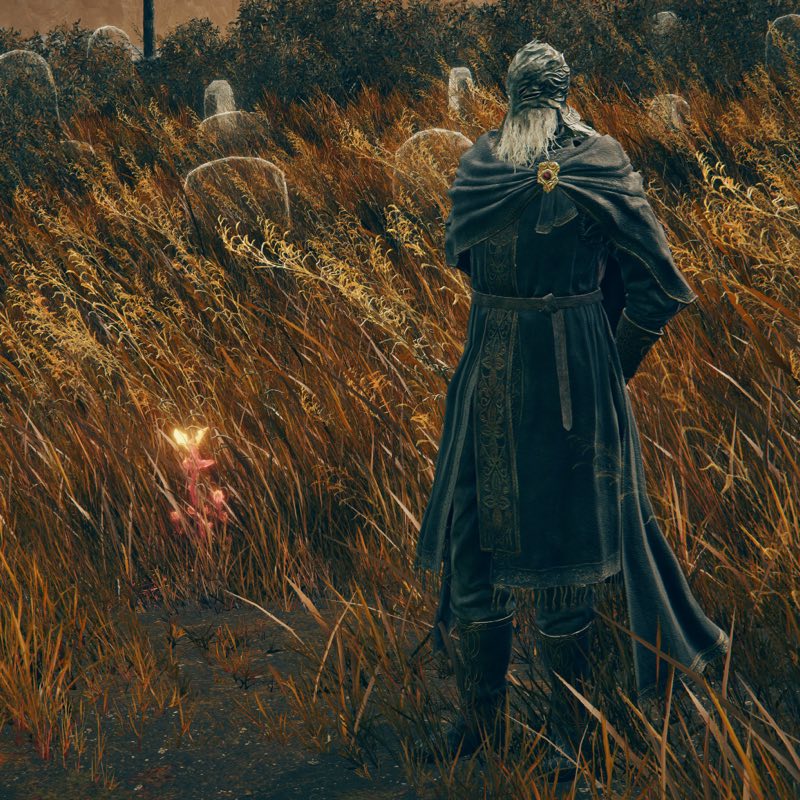
Ansbach is a Pureblood Knight who once served Mohg, Lord of Blood. He challenged Miquella to free his lord from his enchantment, had his own heart stolen instead, and followed Miquella all the way to the Realm of Shadow. When Miquella discards his Great Rune and the charm lifts, Ansbach calls Miquella "a monster" and fears, from the bottom of his heart, the power that "wields love to shrive clean the hearts of men". He also uncovers that Mohg's body, after the protagonist defeated him, is being used as the "vessel" for Miquella's king consort. Ansbach knew his loyalty to Mohg held neither logic nor justice any more. And yet he could not let go of that oath. In a story where Miquella "discards everything" to become a god, we think Ansbach is drawn as the one who could not let go.
Who is Ansbach?
He is the white-haired old knight you meet by a site of grace right after entering the Realm of Shadow in Shadow of the Erdtree:
You must be the Tarnished. I am Ansbach. Formerly in service to Lord Mohg. But now, like you, another soul guided by Kindly Miquella. I’m hardly the steady hand I once was. My fighting days are far behind me.
—— Sir Ansbach
Formerly in service to Lord Mohg. In the base game, Mohg was the gruesome lord who founded a dynasty of blood underground. Many players were surprised that one of his men was such a gentle-mannered old man. More on Mohg in Who Is Mohg?
Ansbach calls himself past his fighting days. But later Leda the Needle Knight says Ansbach was once the leader of the feared Pureblood Knights. He was only being modest; he was a knight of real skill.
What was he investigating in the Realm of Shadow?
Instead of fighting, Ansbach was investigating something:
Which is why I have chosen to dedicate myself to investigation. To discern Tender Miquella’s ultimate purpose. I’d rather not volunteer service to a new master unless I know that I can be of use.
—— Sir Ansbach
His clues were the “Miquella’s Crosses” left across the Realm of Shadow:
They are akin to Tender Miquella’s footprints. Or gravestones, which mark what he’s left behind. If you discover any more crosses, be certain to tell me.
—— Sir Ansbach
Gravestones, which mark what he’s left behind. Each time the protagonist finds a cross and reports it, Ansbach comes closer to Miquella’s purpose. Learning that Miquella has discarded his flesh, his eye, and even his “adoring other self”, Ansbach says:
Tender Miquella’s eye is no mere morsel of flesh. It is a vessel of soaring grace. Proof of his Empyrean lineage. I wonder, does Miquella the Kind intend to sever his very birthright? His fate as a child of the Erdtree?
—— Sir Ansbach
And he works out that Miquella is heading for the “divine gateway” in the tower of shadow:
The full picture is yet to coalesce, but we do know that he is bound for the tower of shadow. And that is where he intends to rise to true godhood… The tower of shadow houses a divine gateway. A well-kept secret, it was, but… The gateway was once the birthplace of a god. A god we know all too well.
—— Sir Ansbach
The gateway was once the birthplace of a god. “A god we know all too well” reads as Queen Marika. The first to put the DLC story’s framework into words was this old knight. The crosses and the flow of the DLC story are covered in Shadow of the Erdtree Story Explained.
Why did he call Miquella “a monster”?
This is the heart of every Ansbach theory.
Partway through the story, Miquella discards his own Great Rune. With that, the charm on his followers lifts. Ansbach, too, remembers “follies better left forgotten”:
Kindly Miquella has discarded his Great Rune. The fog that vexed my aging faculties has been lifted. And follies better left forgotten haunt me once again. Once, in an attempt to free Lord Mohg from his enchantment, I challenged Tender Miquella, only to have my own heart rather artfully stolen. I knew not how weak I was. I believed that with sufficient mastery, even an Empyrean would be within reach of my blade. I could not have been more mistaken… Miquella the Kind…is a monster. Pure and radiant, he wields love to shrive clean the hearts of men. There is nothing more terrifying.
—— Sir Ansbach
Pure and radiant, he wields love to shrive clean the hearts of men.
Ansbach does not hate Miquella. He fears him. Miquella uses no threats and no lies. He is pure, radiant, and he only loves. And yet the hearts of those he loves are wiped clean of what they were.
What Ansbach feared was not Miquella’s strength, but this irresistibility. Ansbach was a knight who challenged Miquella to save his lord Mohg. That knight found himself under the same charm, calling his lord’s captor “Kindly Miquella”, and following him to the Realm of Shadow. When the charm lifted, what was left was regret for his own arrogance, and honest fear:
Righteous Tarnished. Miquella the Kind makes my blood run cold. I am loath to admit it, but even at this very instant I wish to run very far away indeed.
—— Sir Ansbach
More on the charm in What Was Miquella’s Goal?
What had become of Mohg’s body?
Ansbach, who said he wished to run away, stays in the Realm of Shadow anyway. Meeting him again deep in Shadow Keep, he explains why:
After Lord Mohg’s slaying at his dynastic palace, it appears his body has been absconded with. And taken straight to Kind Miquella. Surely you recall that I once served Lord Mohg as a Pureblood Knight. After failing him in every regard, and losing sight of my vows, I’d do anything to make amends, in whatever meagre way I can.
—— Sir Ansbach
When the protagonist finds a clue in the keep and hands it over, Ansbach reaches the truth:
Yes, yes, I should have known. Even the truth was itself mere folly. As if using Lord Mohg to gain entrance to the land of shadow were not enough, he plans to use his corpse as the vessel of his king consort. He has forsaken Lord Mohg’s soul. He desires only his empty shell. It beggars belief, but… I’m afraid Tender Miquella fails to grasp the humiliation implied by this act. One thing is certain. My dear lord deserved better.
—— Sir Ansbach
Tender Miquella fails to grasp the humiliation implied by this act.
This line holds Ansbach’s whole view of Miquella. Miquella has no malice. That is exactly why he never notices that using Mohg’s body as a vessel tramples his lord’s dignity. One who is too pure cannot see another’s pain. Whose “vessel” Mohg’s body became is covered in Who Is Mohg? and Who Is Radahn?
He knew his loyalty held no logic. So why?
Ansbach’s attire tells what was in his heart:
Attire of Sir Ansbach. The embroidered crest of the Pureblood Knights has now all but faded away. Ansbach understood that keeping his oath to his old master was not an act of logic, nor would it bear any justice, but it was for these very reasons he was unable to let go.
—— Ansbach’s Attire
It was for these very reasons he was unable to let go.
Normally, one would let go because there is no logic in it. Ansbach was the reverse. Mohg was a lord drowned in a curse of blood, and the very one who abducted Miquella. There was no justice in serving him still. Ansbach knew that better than anyone.
He could not let go, we think, because it was never a loyalty chosen by reason. He did not serve because it was right. He served because he had sworn to. So learning it was not right was not enough to let it go.
His helm says the same thing from another side:
The iron mask of Sir Ansbach, giving the appearance of a quiet, wise, old bearded man. But an old fear lurks beneath, together with the cold, unflinching discipline that once honed his blade.
—— Wise Man’s Mask
An old fear lurks beneath, together with the discipline that once honed his blade. Outside, a quiet old sage. Inside, fear of Miquella, and a knight’s will that would not fade. One helm shows both faces of Ansbach.
What did he say in the fight with Leda?
Late in the story, Leda the Needle Knight, foremost of Miquella’s followers, begins “purging” companions who show doubt, one by one. Ansbach becomes a target too:
You are thorough indeed, Lady Leda. I would expect nothing less. As you surmise, I do have my doubts. And will not simply lay down and die with them.
—— Sir Ansbach
Here the protagonist can choose between Ansbach and Leda. Side with Ansbach and keep him alive, and he fights alongside you in the final place, Enir-Ilim. There, his self-introduction changes:
I am Ansbach of the Pureblood Knights. I stand with blade aloft, blood afire. For the dignity of my lord and master, Mohg.
—— Sir Ansbach
Not “an old soldier” but “of the Pureblood Knights”. Freed of the charm and knowing the truth about his lord’s body, Ansbach named himself once more as Mohg’s knight. And after the fight with Leda, he says:
Lady Leda. Your suspicions were dead-on. In the end, I could not bury the memories. Of Lord Mohg, and our pact of blood.
—— Sir Ansbach
Miquella came closer to godhood each time he carved a cross and discarded something: his body, his eye, his love. The DLC is a story of those who discard. Within it, Ansbach stands clearly as the one who could not. For us, it is one of the most important lines in the DLC. See the Japanese note below.
Why didn’t he blame the protagonist?
Before the final battle, Ansbach senses the protagonist’s worry and brings it up himself:
It was you, wasn’t it? Who defeated Lord Mohg. Fear not, I bear no grudge against you. His Eminence was felled in an honourable duel, and such are the risks of seeking Lordship. Besides, what right have I to complain? I blame the enchantment more than anything. Righteous Tarnished. We will have our victory. I swear upon my blood.
—— Sir Ansbach
His Eminence was felled in an honourable duel, and such are the risks of seeking Lordship.
What Ansbach could not forgive was not that his lord was defeated. It was that his lord’s body would be used as a vessel, his soul ignored. To fight and lose is an honourable end for one who seeks lordship. To be made an empty vessel is humiliation. What Ansbach was protecting was not Mohg’s life but his “dignity”.
And facing the Promised Consort Radahn, Ansbach declares:
General Radahn. A pleasure to see you, after all this time. But those remains do not belong to you. Lord Mohg will have his dignity.
—— Sir Ansbach
Those remains do not belong to you. Before the divine gate, the old knight raises his blade to take back his lord’s body. After the battle, Ansbach is found quietly dead before the gate. A knight whose heart had been wiped clean by Miquella, who had even forgotten his oath, ended, we think, having taken his oath back.
What about the other companions?
Ansbach was also someone who watched his companions closely.
Of Freyja, another warrior who followed Miquella, Ansbach says: “A true Redmane she is, hardly troubled by the rot. But no-one is without their shortcomings… She has a hard road ahead…”
Of Thiollier, one of Miquella’s followers, after the final fights, he is ashamed of his own prejudice:
I am afraid I underestimated the lad. Appearing frail in both body and mind, I presumed he’d be like to stumble upon the field of battle… What a fool I was.
—— Sir Ansbach
And of Leda, even after they become enemies:
She tends to overestimate… The burden she might carry alone.
—— Sir Ansbach
Those who know their own weakness are kind to the weakness of others. Ansbach was loved by so many players, we think, because of that very human quality of saying his fear and regret out loud.
What the Japanese text says
This site reads the game in the original Japanese. For Ansbach, two key lines carry an image the English loses.
- “In the end, I could not bury the memories.” The Japanese is 「…私は、棄てられませんでした/モーグ様と、我が血の誓いを」: I could not abandon them: Lord Mohg, and my oath of blood. The verb is 棄てる, the very same heavy word for “abandon” carved on every one of Miquella’s Crosses, 「ここに棄てる」. In Japanese, Ansbach’s line is a direct answer to the crosses: Miquella abandoned everything; Ansbach could not. The English “bury the memories” breaks that echo entirely.
- “He wields love to shrive clean the hearts of men.” The Japanese is 「純粋で、輝きに満ち、ただ愛によって人の心を漂白する」: pure, full of radiance, he bleaches people’s hearts with nothing but love. 漂白 is bleaching. Not absolving, but turning white, erasing the colour that was there. That image of a heart wiped blank is the core of Ansbach’s fear.
- “My dear lord deserved better.” 「…我が主が、哀れすぎるではありませんか」: isn’t my lord far too pitiful? The Japanese is a cry of pity, not a judgement.
- Freyja. The Japanese has Ansbach say 「…ええ。存外、私はあの豪傑が好きでしてな」: yes, I am rather fond of that bold warrior, more than you’d think. This warm line does not appear in the English.
- Leda. 「…彼女は、背負いすぎる/自らが思うほど、気丈ではないのに」: she carries too much, though she is not as strong as she thinks. The English keeps the first half; the Japanese adds his gentle worry that she is weaker than she believes.
What we still do not know
How Ansbach challenged Miquella is not told. Whether it was after Mohg abducted Miquella or before is not clear.
How Ansbach became a “Pureblood Knight” is not written either. Where he honed his blade before serving the Lord of Blood, we do not know.
And what became of Mohg’s body, which Ansbach tried to take back at the last, after the battle? The old knight died before the gate, never seeing the answer.