 Kousatsu NoteReading the stories of games, films and anime through their own words
Kousatsu Note / Elden Ring / DLC
 GamesElden Ring DLC
Who Is Romina, Saint of the Bud, in Elden Ring? The Saint Who Turned to the Scarlet Rot in a Burned Church, and the Mother of Forsaken Pests
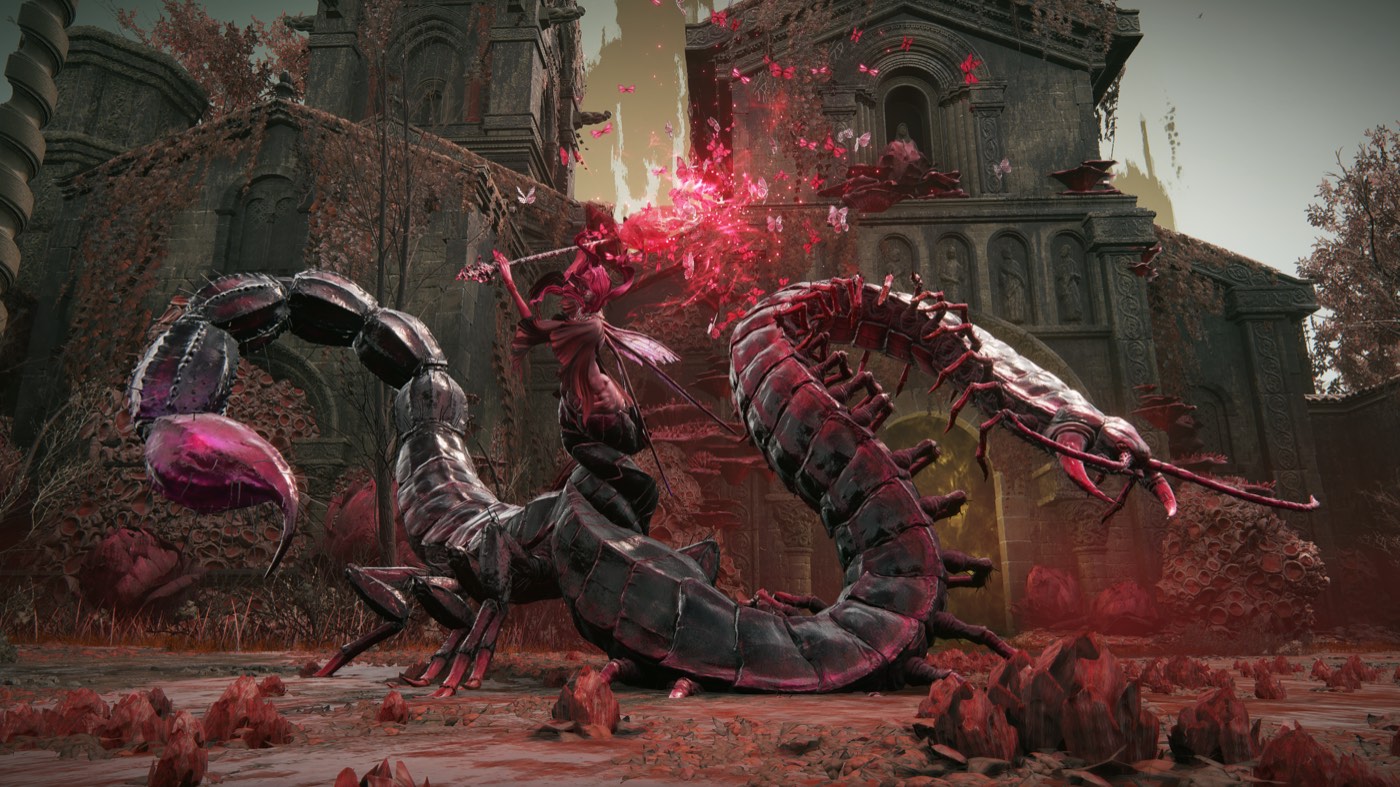
Romina, Saint of the Bud, was the saint of a small church in the Ancient Ruins of Rauh in the Realm of Shadow. The church's symbol was the bud, not yet touched by rot. But the church was burned, and Romina held a bud in speechless silence as it crumbled in flames. In the church burned to the ground, Romina discovered a twisted divine element and turned to the baleful scarlet rot, so that buds might sprout again in the scorched remains. The butterflies that are the Goddess of Rot's wings, and the Kindred of Rot, servants forsaken by that goddess, were without a master. Romina soothed them, and the pests found a mother in her. Romina, we think, was a saint whose church was taken by Messmer's fire, which burned all who lacked the golden blessing, and who tried to become a mother to those left behind.
What is Romina, Saint of the Bud?
Late in the DLC, SHADOW OF THE ERDTREE, deep in the Ancient Ruins of Rauh, a grotesque being waits in a church covered in scarlet flowers.
A human upper body, a scorpion’s tail, a centipede’s body, butterfly wings. She swings a scarlet glaive and scatters scarlet mist. Her name is “Romina, Saint of the Bud”.
Romina has no lines. But the descriptions of her, and of her church, tell the story of one saint.
What kind of place was the Church of the Bud?
The symbol of Romina’s church was the “bud”:
A large, rotten bud that will never come into bloom. Material used for crafting items. Grows in lands blighted by the scarlet rot. There was a time when these buds were not touched by the scarlet rot’s blight — when they were the symbol of the small church deep in the ancient ruins of Rauh.
—— Scarlet Bud
There was a time when these buds were not touched by the scarlet rot’s blight — when they were the symbol of the small church.
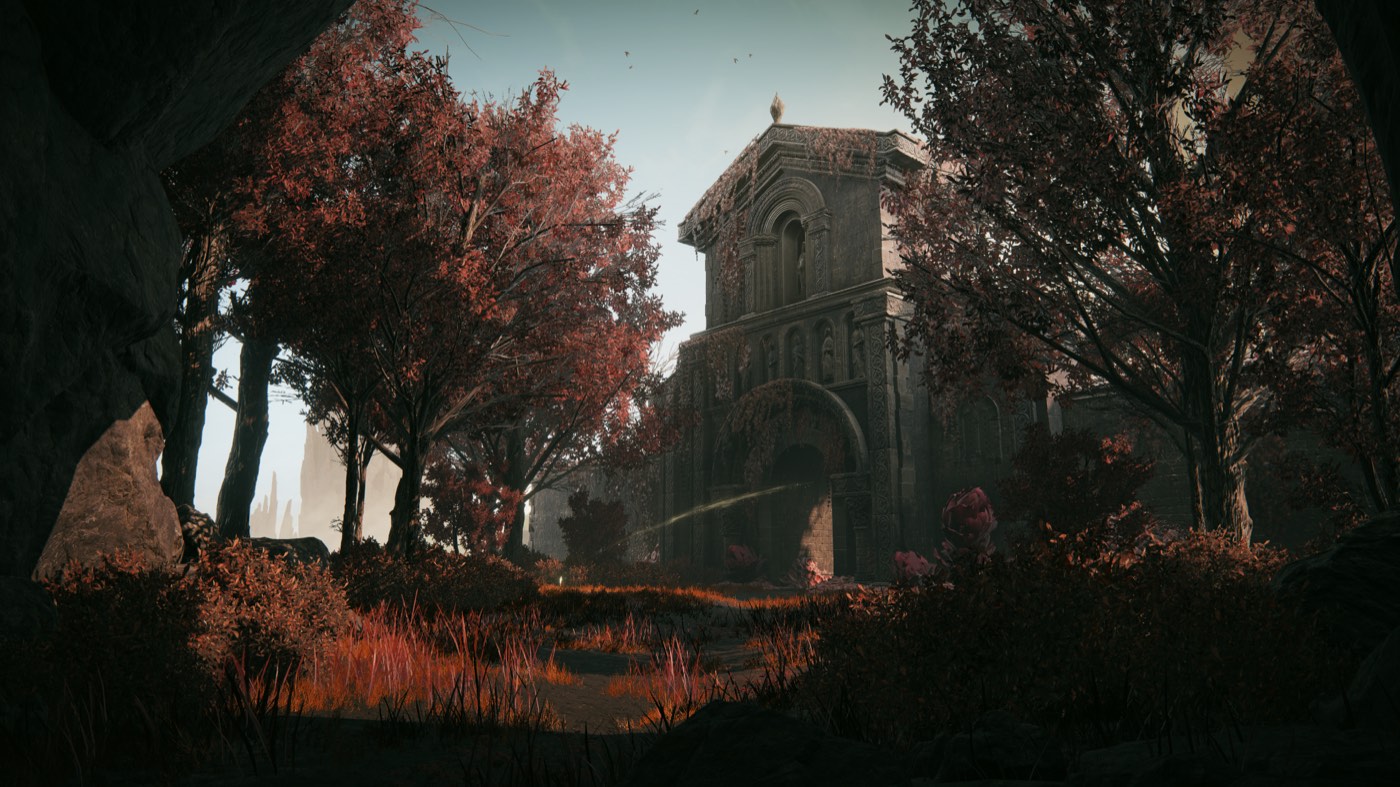
A bud that now rots scarlet and will never bloom. Once, it was the pure symbol of a small church in the ancient ruins. That church’s saint was Romina.
What happened to the church?
Romina’s glaive tells of that day:
Weapon of Romina, Saint of the Bud. A scarlet glaive with a dangling bud-like blade. Attacks cause buildup of rot. Once, in the crumbling, burning church, Romina held the bud in speechless silence. That bud would become her blade.
—— Poleblade of the Bud
Once, in the crumbling, burning church, Romina held the bud in speechless silence.
The church was burned. Who burned it is not written.
But in the Realm of Shadow, there is someone who burned away all who lacked the golden blessing: Messmer the Impaler. Messmer’s army burned those who would not follow the Erdtree all across the Realm of Shadow. It seems natural to think Romina’s church was burned by that fire too. More on Messmer in Who Is Messmer the Impaler?
That bud would become her blade. The bud she held, stunned, in the burning church became, in time, a scarlet blade.
Why did she turn to the scarlet rot?
This is the heart of every Romina theory.
The remembrance you get for defeating Romina says:
Remembrance of Romina, Saint of the Bud, hewn into the Scadutree. (snip) After the church was burned to the ground, Romina discovered a twisted divine element, which she weaved into the baleful scarlet rot. Perhaps then, the buds might find somewhere to gain purchase once more, within the scorched remains.
—— Remembrance of the Saint of the Bud
After the church was burned to the ground, Romina discovered a twisted divine element. Perhaps then, the buds might find somewhere to gain purchase once more, within the scorched remains.
The scarlet rot is a blight that rots everything. In the Lands Between, the flower of rot that Malenia brought to bloom turned Aeonia scarlet. Seen from the Golden Order, it is nothing but “baleful”.
But for Romina, who had had everything burned, it was different. Rot rots life, and at the same time it lets new life sprout. So that buds might take root again in the scorched remains. To make something bloom once more in a place burned bare, Romina turned to a “twisted divine element”: the rot.
For us, Romina’s choice was an answer to the Golden Order’s fire. Messmer’s fire burned away all that lacked the blessing. All that was left to the burned was ash. On that ash, the Erdtree would let nothing grow. So Romina turned to a god who was not the Erdtree. Only rot would let buds sprout in the ashes. More on the scarlet rot and Malenia in Who Is Malenia?
The butterflies of rot, and those without a master
An incantation Romina used describes her bond with the rot:
Incantation used by Romina, Saint of the Bud. Summons a myriad of butterflies while performing a gentle twirl. The butterflies break apart on contact, scattering rot and setting off a chain reaction. The scarlet butterflies are as the Goddess of Rot’s wings. Bereft of a master, they were soothed by Romina, who reached out to them.
—— Rotten Butterflies
The scarlet butterflies are as the Goddess of Rot’s wings. Bereft of a master, they were soothed by Romina.
The scarlet butterflies were the wings of the Goddess of Rot. The Goddess of Rot reads as Malenia, who brought the flower of rot to bloom at Aeonia in the Lands Between. But that goddess is not in the Realm of Shadow. The butterflies were “bereft of a master”. Romina calmed these masterless butterflies and reached out to them.
Why did the pests find a mother in Romina?
The technique of the Kindred of Rot, the pests, also speaks of Romina:
Skill of the pests known as the Kindred of Rot, now wielded as an incantation. Secrete numerous sticky threads, then twist them into two spears launched frontwards. Charge to enhance potency. The pests are abandoned servants, and it is for this reason that they found a mother in the Saint of the Bud.
—— Pest-Thread Spears
The pests are abandoned servants, and it is for this reason that they found a mother in the Saint of the Bud.
In the Lands Between, too, the Kindred of Rot were described as forsaken:
The Kindred of Rot are the servants of the Goddess of Rot—servants that have been forsaken.
—— Kindred of Rot Ashes
Pests that adored their goddess, and were ignored by her. In the Realm of Shadow, those pests found a “mother” in Romina.
A saint whose church was burned and who lost everything. Pests and butterflies forsaken by their goddess, left without a master. The abandoned huddled together in the ashes. That Romina’s body is a grotesque blend of scorpion, centipede and butterfly may be because she took the forsaken, quite literally, into her own body.
Moore, the knight who followed Miquella in the DLC, also wavered: “Our mother abandoned her brood.” Stories of the forsaken children of rot, and of their mothers, are scattered all over the DLC. More in Who Is Moore?
Who are the “children” of the Church of the Bud?
Around Romina are giant spider scorpions:
This breed of scorpion was native to the realm of shadow, but was far smaller in size. Recent giant scorpions are said to trace back to the Church of the Bud.
—— Spider Scorpion Ashes
Recent giant scorpions are said to trace back to the Church of the Bud.
Spider scorpions, once small creatures, grew huge as “children” of the Church of the Bud. The divinity of rot that Romina turned to changed even the creatures around her church.
Why must Romina be defeated?
Past Romina’s church stands the “sealing tree”. Burning it opens the way to the deepest part of the Realm of Shadow, Enir-Ilim, the gate of the god.
The fire for burning the tree came from within Messmer:
The kindling that burned inside Messmer the Impaler, a dark thing, eaten away at by a wicked serpent. Burns the sealing tree said to be found at the old Rauh ruins.
—— Messmer’s Kindling
Burns the sealing tree said to be found at the old Rauh ruins.
Here lies the irony of the story. The fire of Messmer, who likely burned Romina’s church, is used again by the player, just past Romina. Beyond the saint who tried to make buds sprout in the ashes, fire is set once more. More on Enir-Ilim in Shadow of the Erdtree Story Explained
What the Japanese text says
This site reads the game in the original Japanese. The key line about Romina says something different there.
- “Romina discovered a twisted divine element, which she weaved into the baleful scarlet rot.” The Japanese is 「ロミナは異形の神性を見出し/禍々しい、朱い腐敗に縋った」: Romina found a twisted divinity, and clung to the baleful scarlet rot. In Japanese, she does not weave anything into the rot. She 縋る, clings to it, the way one clings to a last hope. The rot is not something she made, but something she held on to.
- “Perhaps then, the buds might find somewhere to gain purchase once more.” 「焼け跡に、また蕾が芽吹くように」: so that buds would sprout again in the burned ruins. The Japanese is not a “perhaps”; it states her purpose, or her prayer.
- “Romina held the bud in speechless silence.” 「ロミナは茫然と蕾を抱いていた」: Romina held the bud, stunned. 茫然 is the blankness of shock. And 「いつか、その蕾は刃となった」, at some point, that bud became a blade, leaves when and how unsaid.
- “Soothed by Romina, who reached out to them.” 「ロミナは、主なき彼らを慰撫し/心を通じていた」: Romina soothed them, the masterless, and their hearts were connected.
- “The small church deep in the ancient ruins.” The Scarlet Bud’s Japanese says 「ラウフの古遺跡の端にある」: at the edge of the ruins, not deep within them.
What we still do not know
Who burned Romina’s church is not written directly in the text. Reading it as Messmer’s army is our reasoning.
Whether the “twisted divinity” Romina found is the god of rot itself, or Malenia, is not clear either.
And what did the Church of the Bud believe in when Romina was its saint? The faith of that small church, before the rot, is never told.